
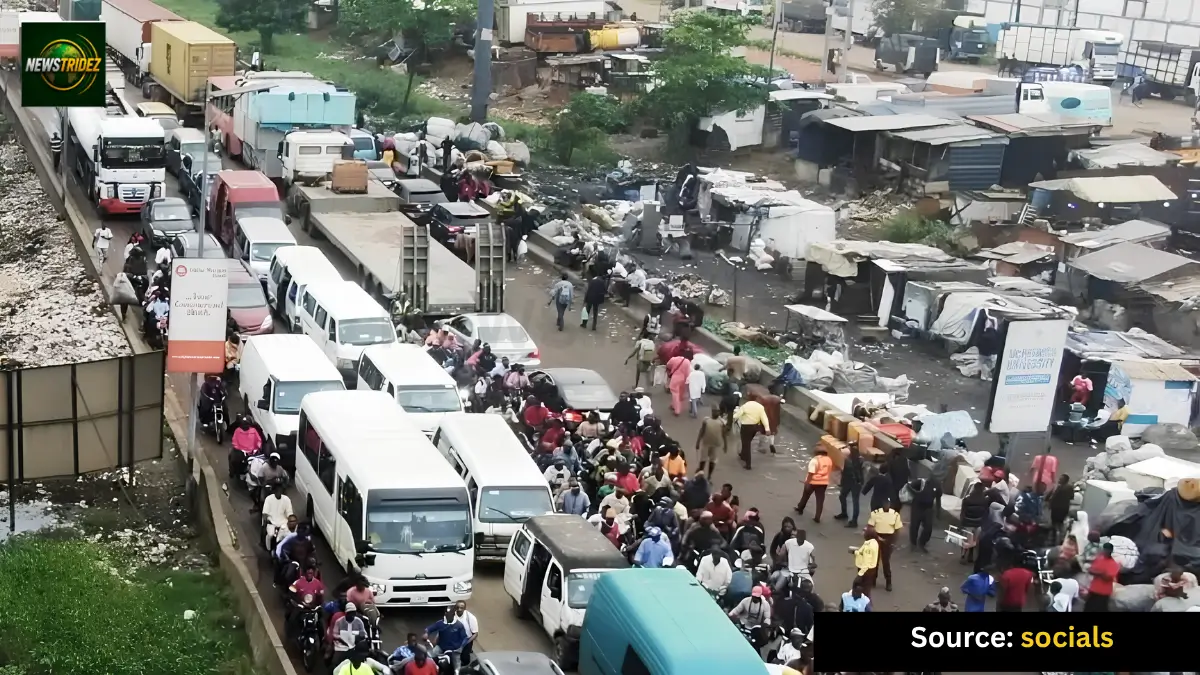
The Lagos-Ibadan Expressway has again become a major traffic nightmare as Kara Bridge repairs leave motorists stranded for hours, while crashes and restricted road space worsen congestion between Lagos and Ogun.
LAGOS, NIGERIA — The Lagos-Ibadan Expressway has plunged motorists and commuters into another round of severe traffic congestion as ongoing repairs on Kara Bridge reduce available road space, with crashes and fallen trucks further worsening movement along the busy Lagos-Ogun corridor.
According to the Federal Ministry of Works, the latest intervention involves replacing deteriorating expansion joints on Kara Bridge and began on September 8, 2026, after an earlier postponement over traffic-management concerns. The two-week project, directed by Works Minister David Umahi, was scheduled to run until September 22.
Newstridez reviewed reports from the Federal Ministry of Works, traffic authorities and on-the-ground coverage of the corridor, showing that the latest disruption is not an isolated traffic incident. The highway has faced repeated repair-related closures, bridge maintenance and crashes, raising fresh questions about how authorities maintain one of Nigeria’s busiest transport routes.
The latest repairs immediately reduced the available carriageway around Kara Bridge, forcing vehicles into controlled lanes. Motorists began reporting long delays shortly after the work started, with congestion stretching from the bridge towards Lagos and affecting adjoining routes around Berger, Otedola and other parts of the Lagos-Ibadan corridor.
The situation became more difficult after a container-laden trailer fell on Kara Bridge on September 15. The incident forced the complete closure of the Lagos-bound section for a period and pushed more vehicles onto the limited available space, causing traffic to spread beyond the immediate repair zone.
Channels Television reported that motorists heading towards Lagos were forced to share part of the available carriageway while officials worked to create another passage. LASTMA and Ogun State traffic officials deployed personnel to manage the situation as authorities tried to restore movement.
Newstridez findings show that the present crisis follows several rounds of repair work on the same corridor. The Federal Government carried out earlier expansion-joint repairs in 2025, while another partial closure covered Kara Bridge, Magboro Bridge and Arepo-Punch Bridge in February 2026. The repeated interventions have left motorists questioning the durability of previous repairs.
The highway itself underwent a much larger reconstruction before the current cycle of bridge repairs. The 127.6-kilometre Lagos-Ibadan Expressway reconstruction began after approval in 2013 and lasted about a decade before completion in 2023. Motorists had endured regular bottlenecks during that period, particularly around the Lagos-Sagamu section.
After the major reconstruction ended, road users expected a more stable travel experience. Instead, maintenance problems around key bridges have continued to cause disruptions. Kara Bridge has become one of the most sensitive points because even a partial closure can quickly affect traffic several kilometres away.
The latest repair work has also exposed how little room the corridor has for additional incidents. When the available lanes narrow, a broken-down vehicle, crash, fallen container or heavy rainfall can quickly turn a difficult journey into a prolonged standstill.
That happened again this week. Channels Television reported that commuters became trapped for hours after the latest crash, with some spending the night in their vehicles. Other motorists reported entering the congestion from different parts of Lagos and remaining on the road through the night.
The human cost extends beyond time spent inside vehicles. Workers risk arriving late at their destinations, businesses lose productive hours and transport operators spend more money on fuel while vehicles remain stuck in traffic.
Commercial transport fares have also risen in some areas. Vanguard reported that some drivers increased fares by more than 200 per cent during the latest disruption, while bus availability dropped along sections between 7Up and Berger. The traffic also spilled onto other routes, including areas around Third Mainland Bridge and Ikorodu Road.
For commuters who depend on public transport every day, the effect can be immediate. A journey that normally takes a manageable period can stretch deep into the evening, forcing workers to spend more money on transport, food and sometimes temporary accommodation.
The congestion has also affected people travelling between Lagos and Ogun for work and business. The corridor connects residential communities, industrial areas, markets and commercial centres, making it difficult for disruptions at Kara Bridge to remain a local problem.
An infrastructure professional quoted by The PUNCH said expansion joints naturally experience wear because of constant traffic, temperature changes and weather. However, he also raised concerns about overloaded vehicles, noting that excessive loading can place additional pressure on roads and bridges.
The issue of heavy trucks remains particularly relevant because articulated vehicles frequently use the expressway to move goods between Lagos and other parts of Nigeria. A mechanical failure or loss of control involving one truck can create a chain reaction when traffic already operates through restricted lanes.
The Federal Government has defended the latest repair as necessary for road safety and structural integrity. Officials have asked motorists to cooperate with traffic managers and avoid unnecessary trips along the affected section while the intervention continues.
The government had also postponed the latest intervention earlier in the year after concerns about the likely traffic impact. The decision to resume the work in September followed further planning around traffic management, but the first days of the exercise showed just how difficult it remains to repair the corridor without causing major disruption.
For the government, the challenge is therefore two-sided. Leaving damaged bridge components unrepaired could create safety risks, while closing part of a major highway creates immediate economic and social costs for road users.
The debate has now shifted from whether the Kara Bridge needs repairs to whether the country can develop a maintenance system that prevents repeated emergency-style interventions. Motorists want repairs that last, while authorities need a system that allows maintenance without repeatedly paralysing major transport corridors.
The PUNCH reported that an infrastructure expert involved in the discussion expected the latest work to last for many years under normal conditions. He also linked premature deterioration to abnormal vehicle loading and urged stronger control of overloaded trucks.
Traffic management has become another major part of the response. Officials from Lagos and Ogun states, LASTMA, the Federal Road Safety Corps and other agencies have been deployed around affected sections, but the scale of the congestion has repeatedly tested their ability to keep vehicles moving.
The repair itself is being carried out in phases, with one portion of the affected bridge closed while motorists use the remaining section. Authorities intend to move the work across as the project progresses, a method designed to keep some traffic flowing while construction continues.
The latest crisis also shows why traffic incidents on the Lagos-Ibadan Expressway can have consequences far beyond the original point of disruption. Once vehicles begin backing up around Kara, congestion can quickly spread towards Berger, Otedola, Ikeja and other connecting routes.
For Lagos residents and people travelling into Ogun State, the immediate concern remains how long the delays will continue. For businesses, the bigger concern is the cost of repeated disruptions on one of the country’s most important commercial corridors.
The Federal Government’s two-week schedule puts the expected completion of the current Kara Bridge rehabilitation at September 22. However, the latest crash and the resulting congestion have added pressure on authorities to restore normal movement while maintaining the safety of workers and road users.
As at the time of filing this report, traffic management operations remained active around the affected sections, while motorists continued to experience delays. The latest disruption has renewed calls for better maintenance planning, stricter enforcement against overloaded vehicles and stronger traffic arrangements before major repairs begin.
The Lagos-Ibadan Expressway remains essential to movement between Lagos and the South-West, but the recurring cycle of repairs, crashes and congestion continues to frustrate the millions of people who depend on it. The immediate priority remains completing the Kara Bridge work safely, while the longer-term test will be whether future maintenance can prevent another cycle of the same hardship.