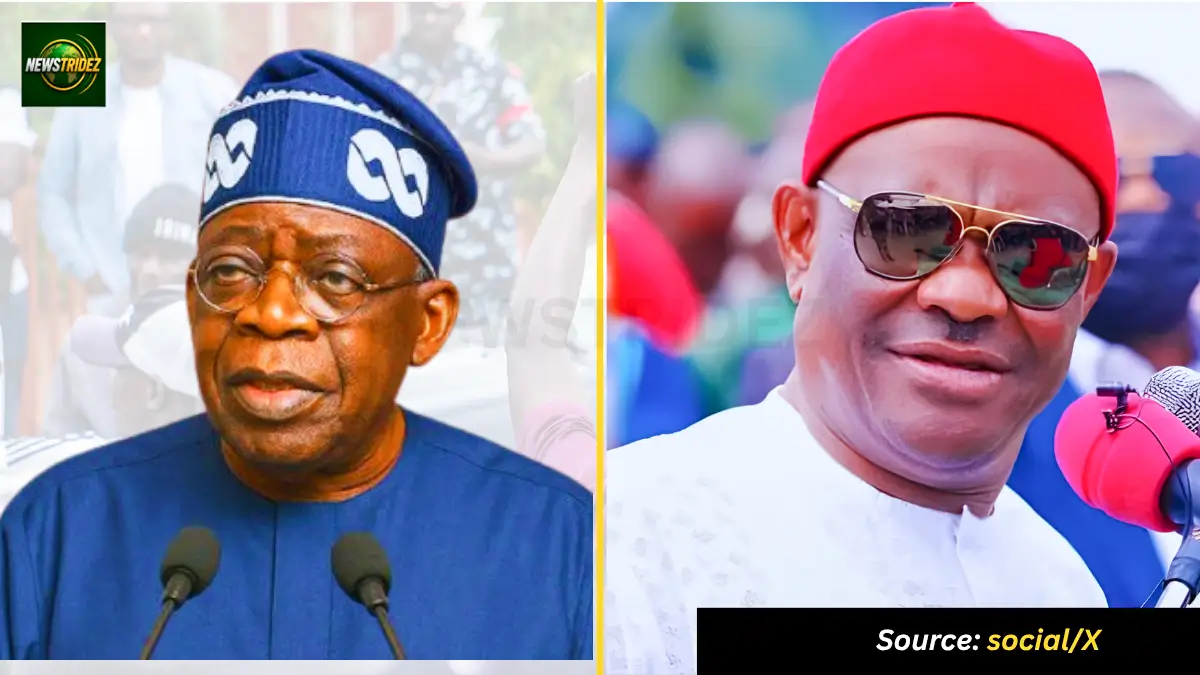

FCT Minister Nyesom Wike has rejected claims that Peter Obi won Rivers State in 2023, while revealing that the G5 governors deliberately allowed Obi to take some South-South states to weaken Atiku Abubakar.
ABUJA, NIGERIA — Minister of the Federal Capital Territory, Nyesom Wike, has dismissed claims that Peter Obi won Rivers State in the 2023 presidential election, saying the official result declared by INEC placed Bola Tinubu ahead of the Labour Party candidate.
Wike made the statement on Monday, September 21, during an appearance on TVC’s Journalists Hangout, where he also disclosed how the five-member G5 governors’ group strategically worked against the presidential ambition of then-PDP candidate Atiku Abubakar during the election.
According to Wike, the G5 governors deliberately allowed Obi to win in some South-South states because they considered Atiku and the strength of the PDP in the region a bigger political concern.
“We said in Edo, PDP is stronger in the South-South. Our problem will be Atiku. Therefore, instead of Atiku to take it, let it go to the Labour Party. That was our strategy.”
Newstridez reviewed Wike’s latest comments alongside the officially reported 2023 Rivers results and found that his account contains two separate issues: the G5’s claimed political strategy and the final result declared by INEC. The official Rivers figures placed Tinubu first with 231,591 votes, followed by Obi with 175,071 and Atiku with 88,468 votes.
Wike said the claim by Obi’s supporters that the Labour Party candidate won Rivers was based on results from selected polling units and social media rather than the final state-wide collation.
He pointed out that Rivers has thousands of polling units across its 23 local government areas, arguing that results from a few locations could not determine the overall winner.
“Out of over 7,000 polling units, until all results have come in, even if 200 polling units come out and say Obi or Atiku has won, it does not convince me.”
The minister also challenged Obi’s supporters to produce the result sheets they relied upon to establish their claim.
“They went to the tribunal, were they able to tender or prove to the court that they won the election?”
Wike added:
“You can win on social media, but I am not interested in social media winning. I am interested practically in the results on the ground, who won, and who was declared.”
The official result reported after collation from all 23 local government areas showed Tinubu of the APC with 231,591 votes, Obi of the Labour Party with 175,071 and Atiku of the PDP with 88,468 votes.
Tinubu therefore led Obi by 56,520 votes in the declared result.
The breakdown also showed that the APC won the state overall, while the Labour Party recorded victories in several local government areas. Reports from the time showed Tinubu won 14 LGAs, Obi five and the PDP four, although some contemporary reports differ slightly on the exact LGA count because of reporting variations.
The result was declared after collation of results from the state’s 23 LGAs.
Checks by Newstridez showed that Obi’s strongest performance included Port Harcourt City, where he recorded 62,451 votes against Tinubu’s 5,562. However, Tinubu secured a large margin in Obio-Akpor, recording 80,239 votes against Obi’s 3,829, according to the published LGA breakdown.
The final state-wide collation, rather than any individual LGA, determined the declared winner.
Wike’s comments went beyond the Rivers result.
He said the G5 governors — himself, Seyi Makinde, Samuel Ortom, Okezie Ikpeazu and Ifeanyi Ugwuanyi — had agreed to limit Atiku’s advantage in the South-South during the 2023 presidential election.
According to Wike, the group believed the PDP was particularly strong in the region and that allowing Atiku to take those votes would strengthen his presidential campaign.
The group therefore decided that Obi could win in some states instead.
“Cross River, the same thing. That’s what we did,” Wike said.
He explained that the strategy was intended to deny Atiku the benefit of the PDP’s regional strength.
“If PDP does not win in South-South, it’s a disadvantage to Atiku. Obi winning will not help Obi anywhere. We did that.”
Wike said Rivers was treated differently, however, because the group believed an Obi victory there could send a political signal they did not want.
“It was only Rivers that said, ‘No, we have a problem here in Rivers. Obi will not win here because if he wins, he sends a signal somewhere, people may not understand it.’ And we stopped… we stopped it.”
The statement is Wike’s account of the G5’s political calculations and has not been independently established beyond his remarks.
Rivers was particularly significant because Wike was the state’s governor at the time and had broken ranks with the PDP’s presidential candidate after the party’s 2022 primary.
Wike and the other G5 governors had demanded that the PDP leadership address what they described as an imbalance in the party’s leadership structure before supporting Atiku.
The disagreement eventually contributed to the governors refusing to campaign for Atiku.
Wike subsequently supported Tinubu during the presidential election, although he remained a member of the PDP.
The 2023 result in Rivers became part of the wider debate over Wike’s political influence because Tinubu won the state despite being the APC candidate in a state controlled by a PDP governor.
Wike Challenges Obi Over Tribunal Evidence
Wike also returned to the legal challenge that followed the 2023 election.
He asked whether Obi and the Labour Party were able to prove their claim before the election tribunal.
The Presidential Election Petition Court dismissed the major challenges to Tinubu’s victory, while the Supreme Court later upheld the result.
Wike used that legal history to challenge the continued claim that Obi won Rivers.
“Let them produce that result sheet that says Obi won,” he said.
The distinction is important: supporters may dispute how votes were recorded or raise allegations about individual polling units, but the officially declared state result remains the basis for the election outcome unless altered through the legal process.
Obi Asked To Wait Until 2031
Wike also used the TV appearance to address Obi’s political plans for the 2027 election.
The FCT minister said the political circumstances that helped Obi in 2023 had changed, pointing particularly to the decline of the Muslim-Muslim ticket debate and what he described as changes in Obi’s support base.
He then advised the former Anambra governor to focus on the 2031 election rather than challenge Tinubu in 2027.
“For this election, leave it for Tinubu. Prepare for 2031. And that’s the truth of the matter.”
That statement is Wike’s political position on the upcoming election and does not determine what Obi or his party will ultimately decide.
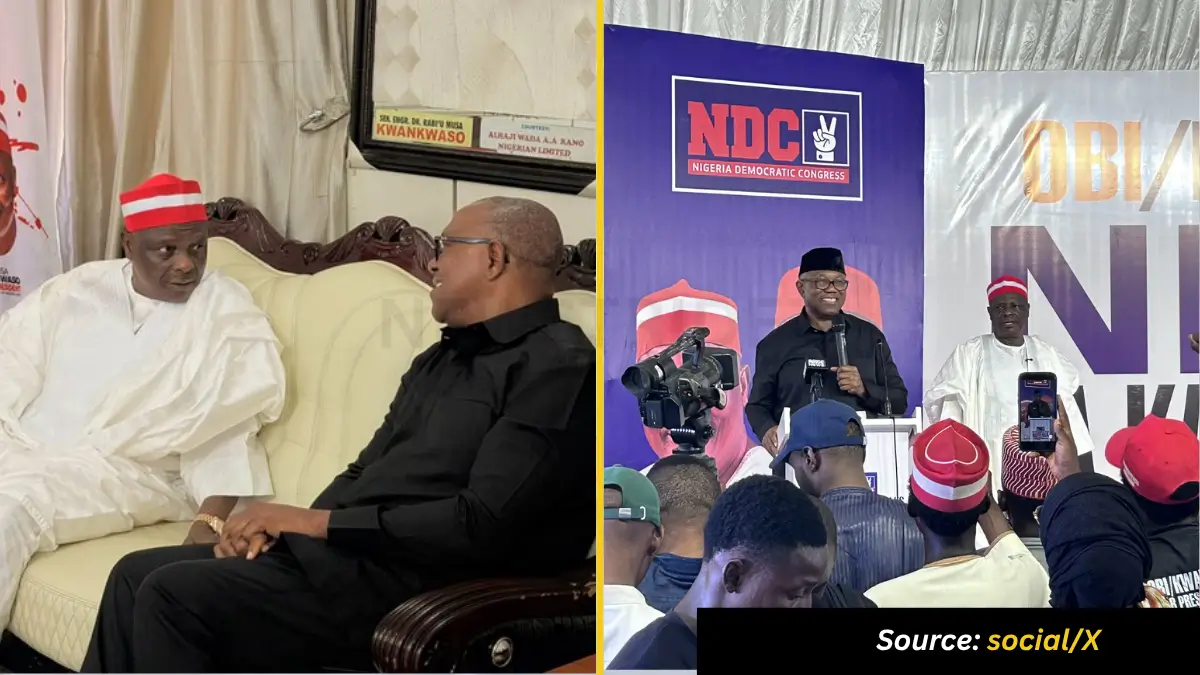
Obi is currently associated with the National Democratic Congress for the 2027 presidential contest, while Wike has continued to publicly support Tinubu’s re-election.
Wike’s Rainbow Coalition
The latest remarks also come as Wike continues to promote his Rainbow Coalition, a cross-party political arrangement that he says is intended to mobilise support for Tinubu’s 2027 re-election.
The coalition has generated disagreement with some APC governors, particularly over whether a cross-party structure supporting Tinubu could create competing political interests at state level.
Wike has maintained that supporting Tinubu for president does not prevent political parties, including the PDP, from fielding candidates for governorship and legislative positions.
That position has brought him into repeated exchanges with APC governors, who have argued that the ruling party needs a unified structure ahead of the election.
Data reviewed by Newstridez indicates that the 2023 Rivers result itself is not in dispute as an officially declared figure: INEC’s reported state result gave Tinubu 231,591 votes, Obi 175,071 and Atiku 88,468. The dispute raised by Obi’s supporters concerns whether those figures accurately reflected the votes cast at all polling units, while Wike rejects that claim.
The difference between those two positions is therefore important when reporting the controversy.
The official result is a recorded electoral fact. Claims that a different candidate actually won would require supporting electoral evidence and, where legally challenged, a successful alteration of the declared result.
As at the time of filing this report, Wike had maintained that Obi did not win Rivers State in 2023, while also acknowledging that the G5 governors deliberately adopted different strategies in parts of the South-South to reduce Atiku’s advantage.
His latest remarks have reopened debate over the role the five governors played in the 2023 election and their political calculations ahead of 2027.
The Rivers result, meanwhile, remains the officially declared outcome of the 2023 presidential election, with Tinubu ahead of Obi after results from all 23 local government areas were collated.
Look at what Wike is saying onnNational TV. Does he not know that suppressing votes of the people is also treason? Just look at that?
— Morris Monye (@Morris_Monye) September 21, 2026
This makes me so upset. He’s already shared the votes and said Obi won’t see votes in delta, Edo etc. pic.twitter.com/PtYJRMH9P0