
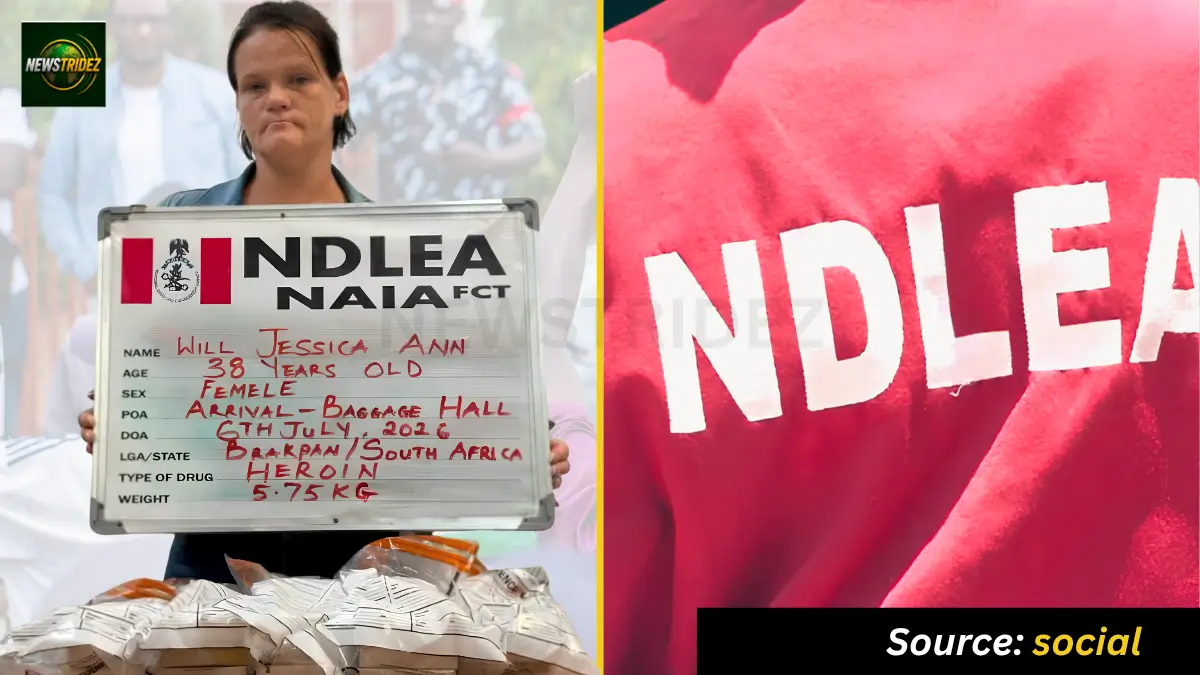
Jessica Ann heroin case has ended with a 25-year prison sentence in Abuja after a Nigerian court convicted the South African woman for importing 5.75kg of heroin through the capital’s international airport.
ABUJA, NIGERIA — A Federal High Court in Abuja has sentenced Will Jessica Ann, a 38-year-old South African woman, to 25 years in prison for importing 5.75 kilogrammes of heroin into Nigeria through Nnamdi Azikiwe International Airport, Abuja, on July 6, 2026. Justice Obiora Egwuatu handed down the sentence on Thursday after Ann pleaded guilty to the drug offence.
According to the National Drug Law Enforcement Agency, Ann arrived in Nigeria on Qatar Airways Flight QR1433 from Doha and travelled with her three-year-old son. NDLEA officers found 14 large blocks of heroin weighing 5.75kg inside two checked suitcases after matching the baggage tags to the claim tags attached to her passport.
Newstridez reviewed the NDLEA‘s July arrest statement, the court reports and Thursday’s sentencing reports, which show that the case moved from arrest to guilty plea and conviction within roughly two months. The court’s latest decision now brings the prosecution against Ann to a sentencing stage, although another suspect named in the case remains at large.
The case began on July 6 when NDLEA officers stopped Ann during the inward clearance of passengers arriving from Doha. The agency said she initially denied travelling with checked luggage, but officers linked the two suitcases containing the heroin to her passport. She later admitted ownership of the bags and reportedly said she had forgotten that she checked them in.
The agency said officers recovered 14 large blocks of heroin from the two suitcases. NDLEA also alleged that Ann travelled from Cambodia through Doha before arriving in Abuja, placing the case within an international drug-trafficking route rather than a purely domestic drug operation.
During her arraignment in August, Ann pleaded guilty to two counts filed by the NDLEA. The charges covered conspiracy to import heroin and unlawful importation of 5.75kg of the substance. The case was registered as FHC/ABJ/CR/422/2026 before Justice Obiora Egwuatu of the Federal High Court in Abuja.
The second person named in the charge, Jan Coenraad De Jager, a South African man, remains at large. Ann admitted during the court proceedings that she conspired with De Jager in the importation, according to reports on the case. NDLEA had earlier described De Jager as her husband or partner and linked him to the alleged trafficking operation.
The prosecution told the court that heroin has a high street value in Nigeria and asked the judge to consider the value of the seized substance while determining the sentence. Channels Television reported that the prosecution put the value of one kilogramme of heroin at about ₦18 million.
Data reviewed by Newstridez indicates that the seized 5.75kg would have a reported street value of roughly ₦103.5 million if the prosecution’s ₦18 million-per-kilogram estimate is applied. That figure is an estimate cited in court proceedings, not an independent Newstridez valuation of the seized substance.
Ann was given an opportunity to speak before the court imposed sentence. She expressed remorse, promised not to engage in such conduct again and told the court that she did not know there were illicit drugs inside the bags, according to reports from the proceedings.
Justice Egwuatu subsequently convicted her after finding that she had admitted the offence in her extra-judicial statement before entering her guilty plea. The judge said the law provides that a conviction follows a guilty plea where the court accepts the plea and the facts support the offence.
The court imposed 15 years on the first count and 25 years on the second count. Justice Egwuatu ordered the sentences to run concurrently, meaning Ann will serve a maximum of 25 years rather than adding both prison terms together.
The judge also directed that the seized heroin should be destroyed if Ann does not appeal within the period allowed by law. The order means the narcotics will remain subject to the court’s directions until the applicable appeal period expires.
The case had earlier attracted attention because Ann travelled with her three-year-old son. At the August arraignment, the prosecution told the court that the child had remained with his mother in NDLEA custody since the arrest. The agency said it wanted to transfer the child to officials of the South African High Commission in Nigeria.
Justice Egwuatu consequently directed the prosecution to file a formal application concerning the child’s custody. The court then adjourned the matter for review of the facts before the eventual sentencing. The child’s situation formed part of the prosecution’s concern during the earlier stage of the case, separate from the drug charge against Ann.
The NDLEA had earlier described the arrest as part of its efforts to disrupt international drug-trafficking networks operating through Nigeria’s airports. The agency said intelligence indicated that Ann was linked to a transnational organisation operating along the Cambodia-South Africa route.
The agency’s account also shows how airport screening officers connected the checked luggage to the suspect. Although Ann initially denied having checked bags, officers compared the baggage tags with the claim information linked to her passport. The discovery led to further examination and the recovery of the heroin blocks.
The arrest took place at a major entry point into Nigeria. Nnamdi Azikiwe International Airport serves Abuja and handles international passengers arriving from several countries, making airport security and baggage screening an important part of Nigeria’s fight against transnational drug trafficking.
The case also comes as Nigerian authorities continue to prosecute foreign nationals arrested over suspected drug offences. NDLEA has repeatedly said international trafficking networks attempt to exploit airports, seaports and other entry points to move prohibited substances into the country.
For Nigeria, the prosecution carries a wider security and public-health dimension because heroin remains a highly addictive illegal opioid. The agency’s enforcement work therefore involves not only arresting suspected traffickers but also intercepting drugs before they reach local distribution networks.
The sentence also demonstrates the difference between an arrest and a conviction. Ann remained a suspect when NDLEA announced her arrest in July, but after she pleaded guilty and the court accepted the prosecution’s case, Justice Egwuatu convicted her and proceeded to sentencing.
Her case was brought under the National Drug Law Enforcement Agency Act, which provides penalties for conspiracy and unlawful importation of controlled substances. Earlier reports on the charge said the conspiracy count carried a prison term of between 15 and 25 years upon conviction, while the unlawful importation count carried a potential life sentence.
The court’s concurrent sentencing therefore means the 25-year term imposed on the second count determines the maximum period Ann will spend in prison under Thursday’s judgment, subject to any successful appeal or other lawful development.
Meanwhile, De Jager remains wanted in connection with the allegations contained in the charge. His continued absence means the wider investigation into the alleged international trafficking network has not necessarily ended with Ann’s conviction.
The NDLEA’s earlier statement said Ann had travelled from Cambodia through Doha before reaching Abuja. That route has become part of the evidence and allegations surrounding the case, although the court’s conviction focused on the offences established against Ann.
The development is also relevant to ongoing Nigeria-South Africa relations because Ann is a South African citizen convicted by a Nigerian court. Her nationality does not remove the jurisdiction of Nigerian authorities over offences allegedly committed within Nigeria, including unlawful importation through an international airport.
As at the time of filing this report, the Jessica Ann heroin case had ended in a 25-year prison sentence after the Federal High Court in Abuja convicted the 38-year-old South African woman on charges connected with the importation of 5.75kg of heroin. The court ordered the two prison terms to run concurrently.
The next legal step available to Ann is an appeal within the period allowed by law. The court also ordered that the seized heroin should be destroyed if no appeal is filed within the prescribed period. Meanwhile, authorities still have an outstanding task in locating De Jager, who the prosecution named as Ann’s alleged co-conspirator.