
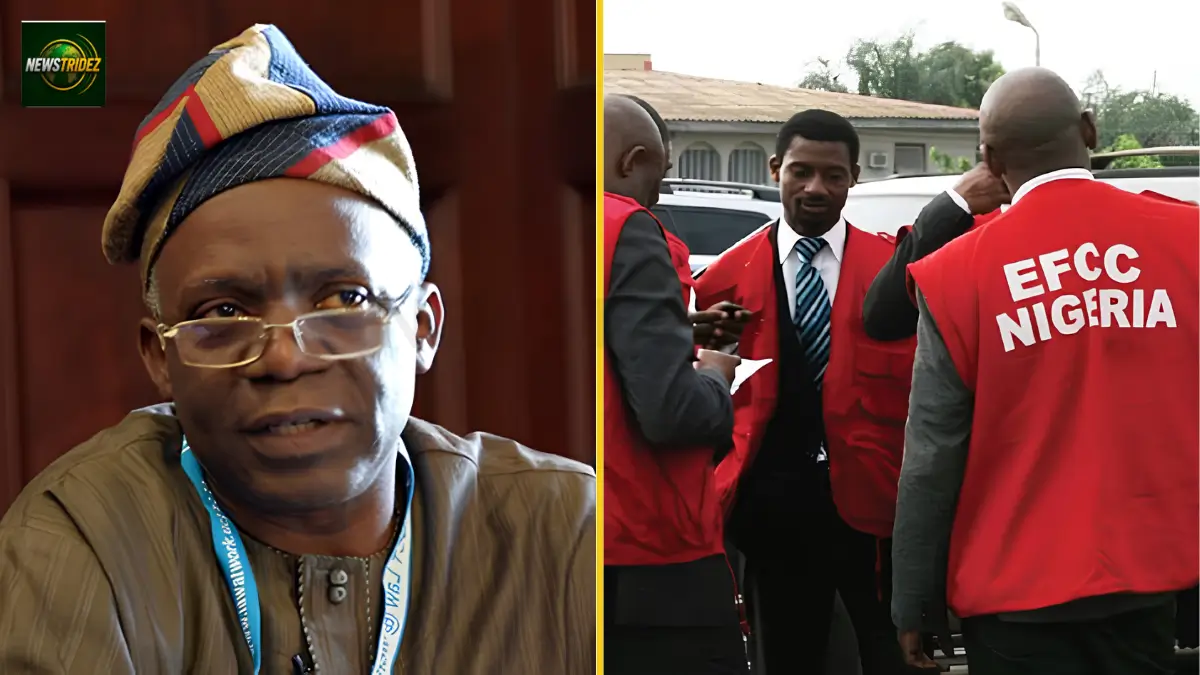
Human rights lawyer Femi Falana has asked the EFCC to investigate N33.75bn cash transfers that auditors could not verify as reaching 3.29 million vulnerable households.
ABUJA, NIGERIA — Human rights lawyer Femi Falana has urged the Economic and Financial Crimes Commission (EFCC) to investigate the alleged failure to account for N33.75bn cash transfers meant for more than 3.29 million vulnerable households in 2023.
The demand followed findings by the Auditor-General for the Federation, Shaakaa Chira, that the Federal Government failed to provide sufficient evidence showing that the money reached genuine beneficiaries. The finding appeared in the Auditor-General’s 2024 Annual Report on Non-Compliance/Internal Control Weaknesses in federal ministries, departments and agencies.
Newstridez’s review of the audit findings shows that electronic transfers amounting to exactly N33.751bn went to 3,295,207 households and beneficiaries listed across 35 states under the National Cash Transfer Office in 2023. Auditors, however, said payment vouchers did not contain enough beneficiary information to independently establish who received the money.
The audit also raised concerns about the failure to provide crucial Remita payment records. Those records would have allowed auditors to reconcile the transfers with the National Social Register and National Beneficiary Register and determine whether the listed recipients were genuine.
The absence of those records does not, by itself, establish that the entire N33.75bn was stolen. Instead, the Auditor-General’s finding shows that the government could not provide sufficient documentary evidence for auditors to verify that the transfers reached legitimate beneficiaries. That distinction is important as the EFCC considers whether criminal wrongdoing occurred.
Falana wants the anti-graft agency to work directly with the Auditor-General’s office to trace the payments, recover any money found to have been diverted and prosecute officials found responsible.
In his statement, the Senior Advocate of Nigeria described the alleged diversion as a serious matter because the funds were designed to support Nigerians facing poverty and economic hardship. He also called for immediate investigation and prosecution where evidence establishes criminal liability.
The controversy centres on the National Cash Transfer Office, which operates within Nigeria’s broader social investment framework. The National Social Investment Programme Agency Act 2022 provides a statutory framework for social intervention programmes, including the National Cash Transfer Programme, N-Power, the National Home-Grown School Feeding Programme and other poverty-reduction initiatives.
Falana said the latest audit finding was especially troubling because the government had already introduced measures aimed at tightening beneficiary verification. These include linking beneficiary records with Bank Verification Numbers and National Identification Numbers to reduce the risk of ghost beneficiaries and improve payment tracking.
The lawyer also pointed to earlier controversies involving the humanitarian affairs ministry and social investment programmes. He recalled the EFCC investigation involving former Humanitarian Affairs Minister Sadiya Umar Farouq over alleged money laundering involving more than N37.1bn.
A Federal Capital Territory High Court issued an arrest warrant against Farouq and her former Permanent Secretary, Bashir Alkali, in April 2026 after repeated failures to appear for arraignment, according to reports cited by Falana.
Falana further referenced the case involving former Humanitarian Affairs Minister Betta Edu, who was suspended in January 2024 after a leaked memo directed the Accountant-General of the Federation to transfer N585m in intervention funds into a private bank account.
He also called for the EFCC to conclude its investigation into former National Social Investment Programme Agency chief executive Halima Shehu, who was suspended and questioned over alleged suspicious movement of funds. Falana said the public should be told the outcome of those investigations.
The latest audit finding has also triggered wider demands for accountability. The Socio-Economic Rights and Accountability Project has separately urged President Bola Tinubu to investigate more than N78.8bn in alleged irregularities, unaccounted expenditure and questionable payments linked to federal cash transfer and social protection programmes.
That broader figure includes the N33.751bn transfer payments flagged by the Auditor-General, as well as other transactions identified in the audit report. The separate demands increase pressure on the government to publish clear payment records and explain how social protection funds were administered.
For millions of Nigerians who depend on government intervention programmes, the issue goes beyond an accounting dispute. Cash transfers are intended to provide direct relief to households struggling with food costs, unemployment and other economic pressures. Any failure to properly track such funds could weaken public confidence in future social protection programmes.
The government also faces the challenge of protecting new poverty-reduction funds from similar accountability problems. Falana raised concerns about a planned $3.05bn development package announced by the Federal Government in July 2026 with World Bank support. He urged the government to establish an independent oversight mechanism involving credible civil society organisations to monitor how such funds reach beneficiaries.
The immediate issue now rests with the EFCC and the relevant government agencies. An investigation would need to establish whether the missing documentation resulted from poor record-keeping, administrative failure, payments to ineligible recipients or deliberate diversion of public funds.
If investigators find evidence of criminal conduct, those responsible could face prosecution and efforts could begin to recover any diverted funds. Until such findings emerge, the N33.75bn remains an amount flagged by the Auditor-General as insufficiently accounted for, rather than money judicially established as stolen.
The pressure on the government is therefore likely to grow as Nigerians demand clearer records showing who received the funds, when the payments were made and whether the beneficiaries matched the approved social registers.