
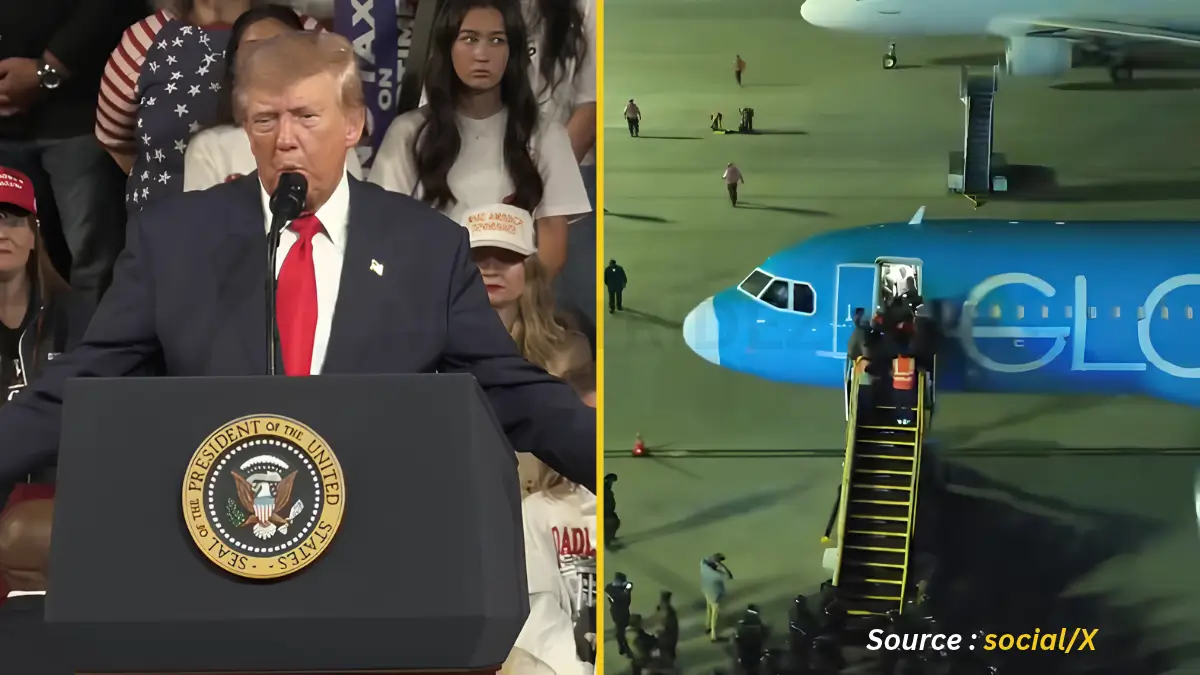
Donald Trump has shared nighttime footage of deportation flights, linking his administration’s immigration crackdown to falling murder rates in the United States. But critics question whether the video proves that deportations caused the decline.
WASHINGTON, UNITED STATES — Donald Trump, the US president, has shared footage of nighttime deportation flights, presenting his administration’s immigration crackdown as part of the explanation for falling murder rates. The post has renewed debate over whether tougher immigration enforcement deserves credit for the decline or whether other factors better explain the figures.
The footage, described in the circulating report as showing GlobalX aircraft and groups gathered during a nighttime operation, highlights the administration’s drive to remove people it says should not remain in the country. Trump has repeatedly linked stricter border controls and immigration enforcement to improved public safety. However, the specific video and its original post could not be independently verified from the available sources, so the exact date, location and circumstances of the operation remain unclear.
The wider argument comes as official figures show a sharp fall in violent crime across the United States. According to the Federal Bureau of Investigation (FBI), murder and non-negligent manslaughter offences fell by an estimated 18.1 per cent between 2024 and 2025. The bureau also reported a 9.3 per cent decline in violent crime overall, while property crime fell by 12.4 per cent during the same period.
The figures give the Trump administration grounds to highlight improvements in public safety, but they do not establish that deportations caused the decline. FactCheck.org reported that crime had already been falling after the pandemic-era surge, with reductions recorded in 2023 and 2024. Researchers have also warned that crime trends can reflect several overlapping factors, making it difficult to assign responsibility to a single policy or political leader.
Trump and his supporters argue that removing people involved in crime can improve public safety. The administration has made immigration enforcement a central part of its law-and-order agenda, using arrests, detention and deportation operations to demonstrate its commitment to tighter controls. Supporters see the flights as evidence that the government is acting on its promises, while critics say the images risk turning serious enforcement operations into political spectacles.
The debate also raises questions about who authorities actually arrest and deport. A Guardian investigation published in February 2026, based on immigration records, found that 77 per cent of immigrants placed in deportation proceedings in the documents it examined had no criminal conviction. The investigation also found that fewer than half had criminal charges. The findings challenge the suggestion that deportation operations exclusively target people convicted of serious offences.
Immigration enforcement and criminal justice also involve different legal questions. A person may face removal proceedings for violating immigration law without having committed a violent crime. Deportation itself does not establish that someone is responsible for murder, assault or another serious offence. That distinction matters when political leaders use footage of removal operations to explain changes in national crime statistics.
Critics have questioned both the presentation of the flights and the suggestion that immigration enforcement explains the falling murder rate. Their concerns include due process, the treatment of people in detention and the risk of drawing broad conclusions from images that may not show the full circumstances of an operation. Legal challenges over deportation procedures have also continued to raise questions about whether affected people receive a meaningful opportunity to contest their removal.
Meanwhile, experts have pointed to the timing of the crime decline as a reason for caution. The Council on Criminal Justice has reported falling homicide levels in cities with different policing strategies, economic conditions and political leadership. Researchers have also discussed factors such as changes in criminal activity, local policing and the effects of the pandemic-era crime surge. The available evidence does not establish immigration enforcement as the single cause of the national decline.
Newstridez’s review of the FBI’s published figures and available reporting found a clear distinction between the documented decline in crime and the administration’s explanation for it. The FBI provides the statistics on reported offences, while the claim that deportations drove the decline remains a political interpretation that requires separate evidence. The figures cover the United States as a whole and cannot, on their own, establish the effect of a particular deportation operation or policy.
The issue also carries implications beyond the United States. Nigeria and other countries whose citizens live in America are watching changes in immigration enforcement because deportations can affect families, employment, remittances and travel plans. Nigerians facing removal proceedings may also need to understand that immigration violations and criminal convictions are not the same thing, and that individual cases depend on their circumstances and the applicable law.
The next stage of the debate will depend on more detailed evidence showing how immigration enforcement relates to crime trends, alongside information about arrests, convictions and deportations. Until researchers can establish a stronger link, the FBI’s figures support the conclusion that crime fell sharply in 2025, but not the claim that deportations alone produced the decline.
THIS IS WHERE WE SEND OUR KILLERS, DRUG DEALERS & THUGS. THIS IS WHY MURDER AND OTHER CRIMES IN AMERICA ARE AT RECORD LOWS. https://t.co/NgdPvknXqH
— Donald J. Trump (@realDonaldTrump) October 14, 2026