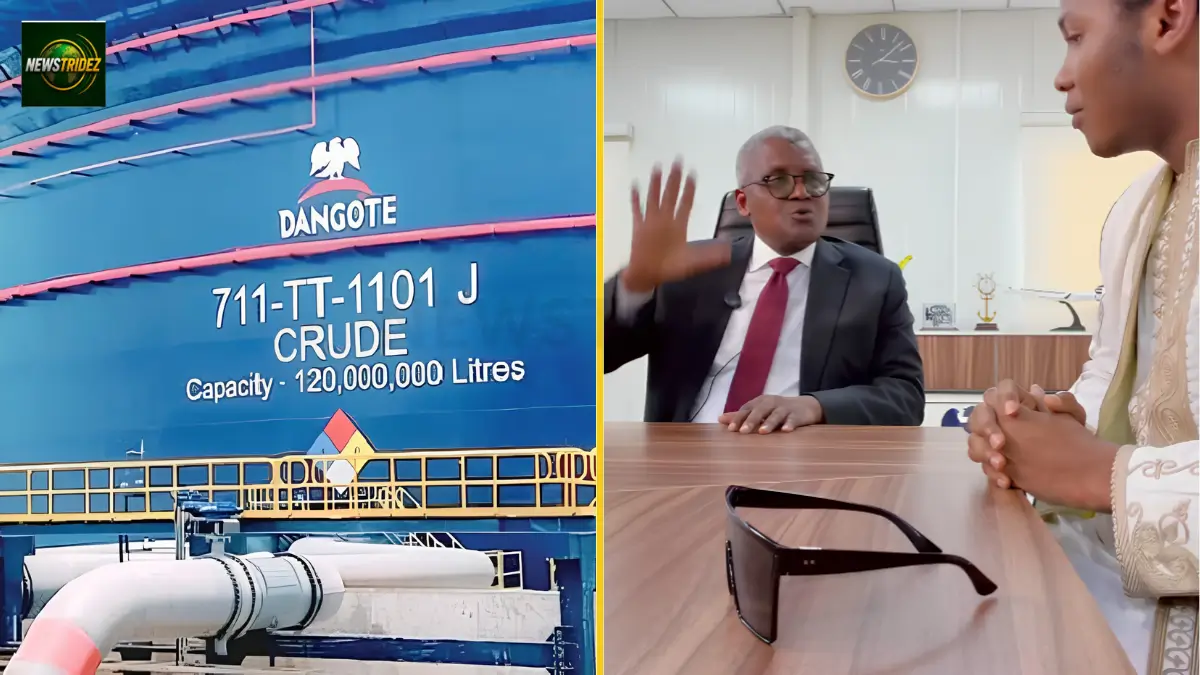
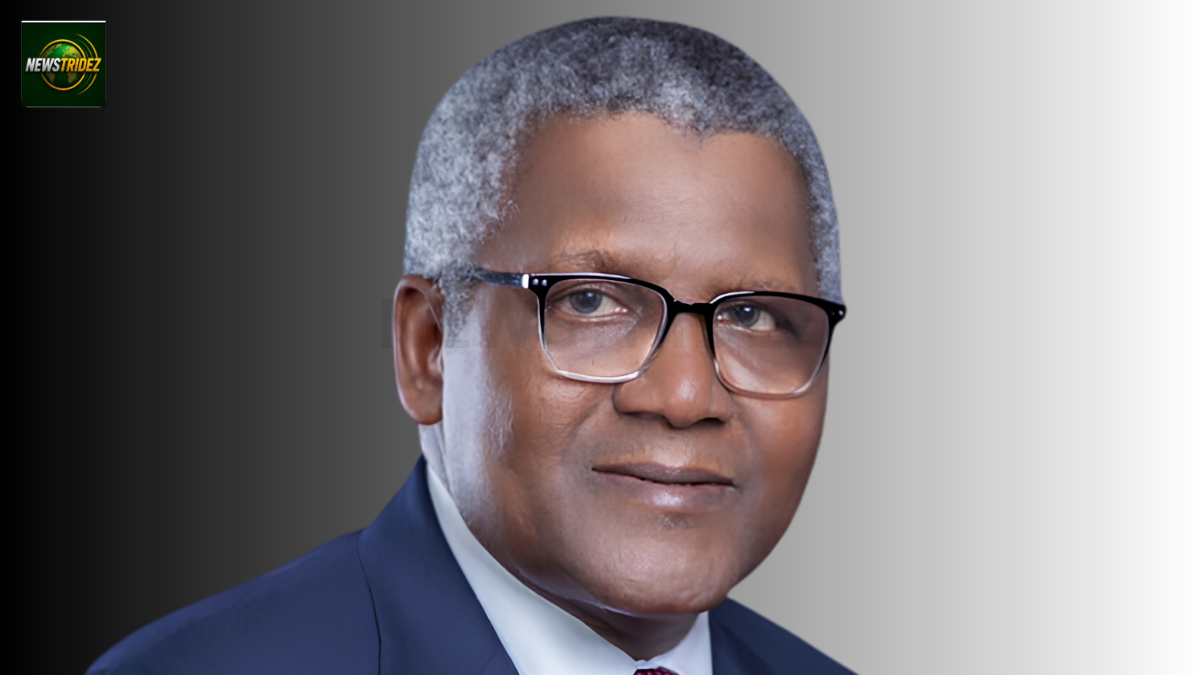
Aliko Dangote has revealed that he bought his first private jet at 22 and a half while speaking in Lagos on Monday, urging wealthy Nigerians to invest more in production.
LAGOS, NIGERIA — Africa’s leading industrialist, Aliko Dangote, has disclosed that he acquired his first private jet at 22 and a half, recalling his early success while urging wealthy Nigerians to channel more money into productive investments.
According to Dangote, his attitude towards luxury has changed after decades in business, and he now has no problem travelling on commercial flights. He made the disclosure on Monday at the Nigerian Exchange in Lagos during the formal launch of the Dangote Petroleum Refinery and Petrochemicals IPO.
Checks by Newstridez show that Dangote’s comment formed part of a wider appeal to Nigeria’s wealthy class to move money from luxury consumption into factories, manufacturing and other productive ventures. He said the country could not become a great nation without increasing production and creating economic value.
Dangote said he had enjoyed the benefits that came with his success, but his priorities had changed with age and experience. He explained that he could now take a commercial flight when necessary, despite having owned a private jet from his early twenties.
“I had my first private jet at 22 and a half years old,” Dangote said.
The billionaire industrialist then turned his attention to wealthy Nigerians who spend huge sums on private aircraft. He urged them to consider investing some of that money in factories and businesses that can create jobs, increase local production and support Nigeria’s economic growth.
Dangote said his position was not based on opposition to private jets, pointing out that he himself had enjoyed that lifestyle at a young age. Rather, he argued that the bigger issue was how wealthy Nigerians deploy their resources in a country that still needs more productive businesses.
“We are not going to be a great nation without doing something productive,” he said.
He also recalled a recent experience in Abuja that reinforced his concern about the country’s spending priorities. Dangote said he spent about 30 minutes searching for a parking space and wished the city had more factories instead of large numbers of private aircraft.
Newstridez reviewed the comments and the circumstances surrounding them and found that Dangote made the disclosure at a major moment for his business empire. His remarks came as Dangote Petroleum Refinery and Petrochemicals formally opened its public share offer on the Nigerian Exchange, allowing Nigerians and other investors to buy into the company.
The refinery’s IPO offers 4.1 billion ordinary shares at ₦525 per share, putting the potential value of the offer at about ₦2.15 trillion if fully subscribed. The public offer opened on September 14 and is scheduled to close on October 13, according to reports on the launch.
The timing gave Dangote’s comments an added economic message. While reflecting on how his own wealth developed, he was also presenting the refinery listing as a way of moving capital into productive investment and widening Nigerian ownership of a major industrial asset.
The Dangote Refinery sits in the Lekki area of Lagos and has a reported capacity of 700,000 barrels of crude oil per day. The company has also outlined plans to increase capacity, making the refinery one of the biggest industrial projects in Nigeria.
For Nigerian investors, the IPO has therefore become more than a corporate fundraising exercise. It offers individuals and institutions an opportunity to hold shares in a refinery that sits at the centre of Nigeria’s efforts to increase domestic refining and reduce dependence on imported petroleum products.
Dangote has repeatedly linked industrial production with Nigeria’s economic future. His latest remarks fit into that wider argument: wealthy Nigerians should not only accumulate assets but should also consider putting capital into businesses capable of producing goods, creating employment and supporting the wider economy.
His comments also come at a time when Nigerians continue to debate wealth inequality, luxury consumption and the difficulty of doing business in the country. The contrast between expensive imported luxury assets and the need for more factories is likely to keep the discussion alive among business owners, investors and policymakers.
The industrialist also pointed to his own experience as an example of how priorities can change. Although he bought his first private jet at a very young age, he said he no longer considers private air travel essential and is comfortable using commercial aviation.
That statement is significant because Dangote has spent much of his career building businesses in sectors ranging from cement and food to oil refining. His current focus on production reflects the direction of the Dangote Group, whose largest recent project has been the refinery.
Data reviewed by Newstridez indicates that the refinery IPO could become one of the largest capital-market transactions in Nigeria, with the company seeking about ₦2.15 trillion from the public offer if investors take up all 4.1 billion shares at ₦525 each.
The listing also gives Dangote an opportunity to deepen public participation in one of Nigeria’s most closely watched industrial projects. For ordinary investors, however, buying shares remains an investment decision that carries market risks and should not be confused with a guaranteed route to wealth.
Meanwhile, Dangote used the occasion to praise President Bola Ahmed Tinubu for what he described as bold economic decisions, including the removal of fuel subsidy and changes to the foreign-exchange market. He said the Dangote Group would continue working with government to support Nigeria’s development.
The billionaire’s comments about private jets also underline the broader economic argument behind the refinery project. Nigeria needs more domestic production, and large-scale investment in manufacturing can reduce import dependence while creating jobs and supporting local supply chains.
I Had My First Private Jet at 22, But Now I Can Even Fly Commercial. I had to spend 30 minutes to get a parking space at Abuja airport because of the number of private jets at the airport and I wish they were factories
— Nigeria Stories (@NigeriaStories) September 14, 2026
~ Billionaire Aliko Dangote says pic.twitter.com/0cByohNxPY
However, Dangote’s account of buying a private jet at 22 should be understood as a reflection on his personal business journey, not as a claim that young Nigerians should measure success through luxury assets. His central message was that wealth becomes more useful to the country when it supports productive activity.
As at the time of filing this report, Dangote had disclosed that he bought his first private jet at 22 and a half and urged wealthy Nigerians to redirect more resources towards factories and production. His comments came as investors began considering the Dangote Refinery IPO on the Nigerian Exchange.
The refinery share offer will now put Dangote’s call for productive investment to a practical test, as Nigerians and institutional investors decide whether to take a stake in the business. For Dangote, the message remains clear: personal wealth can create comfort, but productive investment can create a wider economic impact.